Chapter 1 of 10 · Free to read
How people went from typing keywords to asking a question, in about four years, and why that changes what your business needs to do.

A question, not a search
People have stopped typing keywords and started asking full questions. Whoever is named in the answer gets the first look.
Picture someone who has just moved to a new town and has toothache. Not a great week.
A few years ago they would have typed a couple of words into Google, scrolled past the adverts, opened four or five websites and tried to work out which practice looked trustworthy. It took a while, and they did all the judging themselves.
Today a growing number of people do something different. They open ChatGPT, Gemini or Google itself and simply ask, in their own words.
How many? In the United States, the share of adults who have used ChatGPT rose from 18% in 2023 to 44% in 2026.10 Across six countries, weekly use of AI tools to look things up more than doubled in a single year, from 11% to 24%.11
Example
The old search: dentist near me
The new question: “I’ve just moved here, I’m nervous about dentists and I need an appointment this week. Who would you recommend, and why?”

Look at how much more the second one says. It tells you who the customer is, what worries them and how soon they need help. That’s a gift, if you’re ready for it.
Back comes a short answer. It usually names a handful of businesses and says why each might suit.
In the answer, or out of it.
If yours is one of them, you’re in the running before that person has looked at a single website. If it isn’t, you may never know the question was asked.
The business that has already answered those worries in writing is the one with something to quote. This guide is about being that business, and it starts with what has changed.
The old way versus now
The customer’s side changed first. The business side has to follow.
For your customer
| The old way | Now |
|---|---|
| Types a few keywords: “dentist near me” | Asks a full question, with their situation in it: “Who’s good with nervous patients near me?” |
| Gets a page of links and adverts | Gets one answer that names a few options |
| Opens several websites to compare | Asks a follow-up in the same conversation |
| Does the judging themselves | Lets AI make the first cut |
For your business
| The old way | Now |
|---|---|
| Aim for page one | Aim to be one of the names mentioned |
| Think in keywords: “puppy training classes” | Think in questions: “How long does it take to house-train a puppy?” |
| Write to rank | Write to be quoted |
| Your website is the source | Your whole footprint is the source |
| Post often | Answer well |
Keep these two lists in mind. The chapters that follow take these lines one at a time.
Hot tip
Nothing you have already done for your website is wasted. This guide builds on what you have. It doesn’t ask you to start again.
How we got here
It feels as though AI has always been around. In fact the whole shift has taken about four years.
- November 2022. ChatGPT opens to the public.1 Within about two months, analysts at UBS estimate 100 million monthly users, the fastest growth they can recall for a consumer app.2
- May 2023. Google announces an experiment that puts AI-written answers into its search results. It calls it SGE.3
- May 2024. Google launches AI Overviews to everyone in the United States.4
- October to December 2024. ChatGPT gains built-in web search, first for paying users, then for anyone with a free account.5 It can now name real, current businesses.
- July 2025. OpenAI launches ChatGPT agent, built to carry out tasks for people, shopping included.6 Around 10% of the world’s adults have adopted ChatGPT.1
- May 2026. Google reports more than 2.5 billion monthly users of AI Overviews, and over 1 billion for its newer AI Mode.9

Four stages, in my own shorthand
- Stage 1, the toy. People try it for fun, to see what it will do.
- Stage 2, the helper. It starts writing things: emails, summaries, first drafts.
- Stage 3, the adviser. It can search the web, so people ask it what to choose and who to use. This is where it became your problem.
- Stage 4, the doer. It begins to book, buy and arrange things for people.
Why people switched
It’s easier, it feels finished and it’s instant. That is a hard habit to give up.
This part is my own read of it, backed by numbers where I have them.
The answer comes to you. With a search engine you typed a few keywords and then did the real work yourself: opening websites, comparing them, scrolling. With AI you ask, and the result is handed over. You still need to know what to ask. You no longer have to go and dig.
One answer feels finished. A page of links is a job to do.
An answer is a job done.
We want it now. People take the quickest route to an answer. Researchers have called it the principle of least effort since the 1940s.12 Google once slowed its own results by less than half a second as a test, and people searched measurably less.13 AI hands the answer over at once. Years of scrolling have only sharpened the habit, in my view.
It’s in your pocket. More than half of all web browsing now happens on a phone, up from about a third in 2015.14 AI has followed. One measurement firm counted roughly twice as many people using AI assistants on mobile at the end of 2025 as a year earlier.15
It moved into everyday life. When a team including OpenAI’s own researchers studied how people really use ChatGPT, they found that messages unrelated to work had grown from 53% to more than 70% of all use. Practical guidance, seeking information and writing made up nearly 80% of conversations.1
It feels like advice. In a 2026 survey of 1,002 adults in the United States, 42% said they trust AI recommendations as much as traditional reviews.8
You may have heard… “SGE”
You may have heard people talk about “optimising for SGE”. Let’s see what it actually means.
SGE was Google’s name for its AI answers while they were an experiment in 2023.3 When Google launched them to everyone in the United States in May 2024, it called them AI Overviews.4 Same idea, newer name. If someone is still selling you “SGE”, they’re a couple of years behind.
What this means for your business
When Google puts an AI answer at the top of the page, a lot of people never carry on to a website. They’ve already got what they came for.
For twenty years the goal was simple. Get onto the first page of Google, and the people searching would click through to your website. Ranking meant visitors, and visitors meant enquiries.
That link is weakening. Google now often puts an AI-written answer at the very top of the page, above every website. The search still happens. The visit often doesn’t.
Quick look
On your phone, search Google for a question a customer might ask. A written answer above the websites is the AI answer, labelled “AI Overview”. Not every search shows one.
They’ve already got their answer.
Ask ChatGPT or Gemini and you get the same kind of reply: a short one that names a few businesses and moves on.
Put plainly, being named in the answer now matters more than sitting somewhere underneath it.
The numbers behind it
Researchers at Pew Research Center tracked what 900 adults in the United States actually did on Google.7 Out of every 100 searches, here is how many ended with a visit to a website.
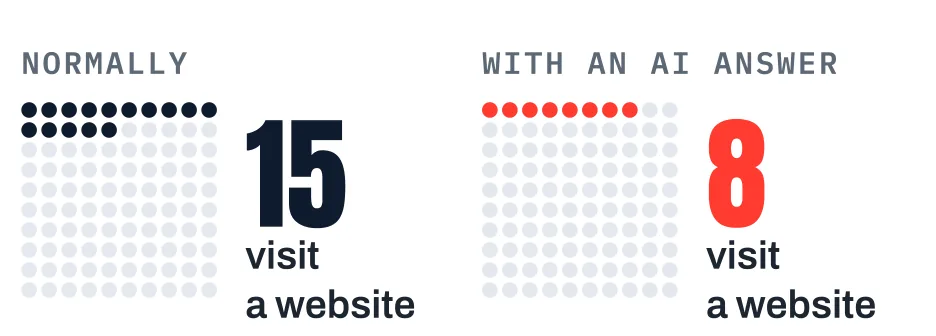
The links inside the AI answer don’t make up the difference. People clicked one of those in about 1 search in every 100.
They were also more likely to stop altogether: about a quarter closed the page after an AI answer (26%), against about one in six without one (16%).
A pattern across searches, not proof of cause.
From everyone to the few
An AI answer works like a funnel. Lots of businesses go in at the top. Only a few names come out at the bottom.
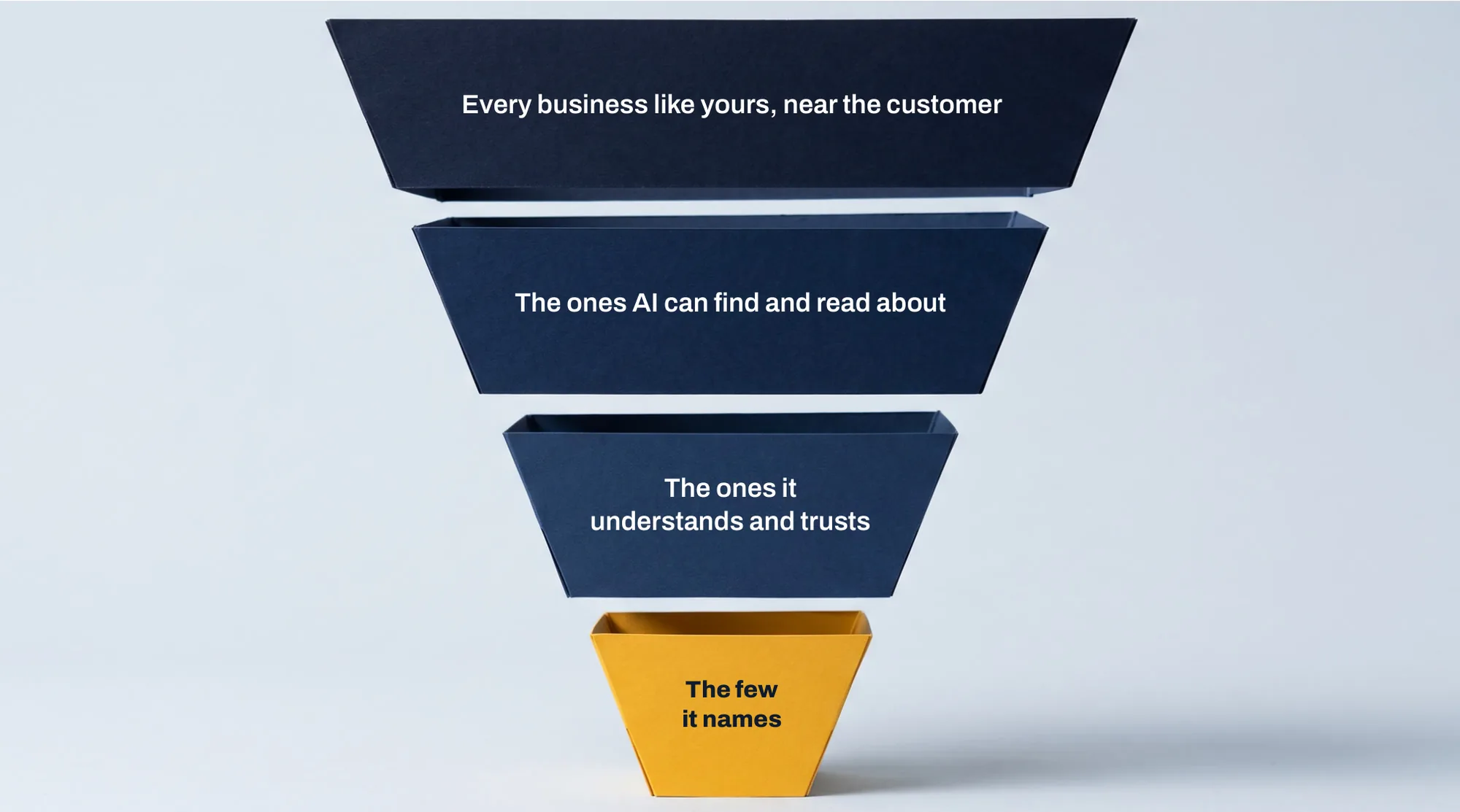
In my experience, most businesses drop out at the second and third levels, and not because they are worse at what they do.
They drop out because nothing clear has been written about them for the AI to read.
That is the part you can change. You can’t control what the AI says, but you can control what there is for it to find.
The rest of this guide takes those two middle levels one step at a time.
Is Google search dead?
No. The old way of searching is slipping, AI is rising, and your customers now use both.
You may have heard… “Google search is dead”
You may have heard people saying nobody searches on Google any more. Let’s see what’s actually true.
In a 2026 survey of 1,002 adults in the United States, Google was still the most used place to read reviews of a local business, at 71%. That is down from 83% a year earlier, so it is slipping, but it is a long way from dead.8 And AI Overviews are part of Google.4
In that same survey, the share of people using AI tools for local recommendations went from 6% to 45% in a year, making AI the third most popular source.8 One survey is a signal, not a census, but the direction is clear.
Not one or the other. Both.
The honest picture is that you now need both. The good news: the work in this guide serves both.

Is Google itself dead? Absolutely not. Search may be slipping, but Google is thriving with AI. It took a hit when ChatGPT first came out, then jumped into the game with both feet, and it has been in AI for years through machine learning. The new toolkit it has brought out, Antigravity, Gemini, Nano Banana and Stitch among them, is phenomenal. The slipping I mean is the search engine only.
Three things have held steady while everything else moved: clear answers to real questions, facts with sources, and a business people can see is real.
The promise, and your first task
By the end of this guide, your business will be in the strongest position it can currently be in to be found by AI, quoted by it and shown to customers.
That is a promise I can keep. It doesn’t say AI will show your business every time. It says that nobody doing this properly will be better placed than you are.
Before you read another page, find out where you stand today. It takes ten minutes. Keep the result. You’ll run the same test again once you’ve put this guide to work, and that’s how you’ll measure progress.
Your turn: the ten-minute test
- Write the question. One a real customer would ask, in their words, with your town in it.
- Ask it three times. In ChatGPT, Gemini and Google. All have a free version.
- Note the names. Which businesses appear, and whether yours is one of them.
- Check the facts. Is what it says about you accurate and up to date?
- Date it, keep it. This is your starting line. Everything else is measured against it.
Secret sauce
Ask the AI about your own business before you change anything. What it says today tells you exactly where to start.
Next, chapter 2: how AI decides who to mention, and the four things it looks for.
The guide · 2027 Edition
Does AI show your business to customers?
The whole method in 138 pages: the test, the prompts and a 90-day plan.
Sources for this chapter
Every link was opened and checked on 13 October 2026.
- Chatterji, Cunningham, Deming, Hitzig, Ong, Shan and Wadman, “How People Use ChatGPT”, National Bureau of Economic Research, Working Paper 34255, September 2025. Two of the authors work for OpenAI. nber.org/papers/w34255
- Reuters, “ChatGPT sets record for fastest-growing user base”, February 2023, reporting a UBS study. Read in the copy republished by Cyprus Mail. cyprus-mail.com/2023/02/05/chatgpt-sets-record-for-fastest-growing-user-base
- Elizabeth Reid, “Supercharging Search with generative AI”, Google, 10 May 2023. blog.google/products/search/generative-ai-search/
- Elizabeth Reid, “Generative AI in Search: Let Google do the searching for you”, Google, 14 May 2024. blog.google/products/search/generative-ai-google-search-may-2024/
- 9to5Mac, “ChatGPT Search is now available to everyone for free”, 16 December 2024. 9to5mac.com/2024/12/16/chatgpt-search-free/
- TechCrunch, “OpenAI launches a general purpose agent in ChatGPT”, 17 July 2025. techcrunch.com/2025/07/17/openai-launches-a-general-purpose-agent-in-chatgpt
- Athena Chapekis and Anna Lieb, “Google users are less likely to click on links when an AI summary appears in the results”, Pew Research Center, 22 July 2025. Based on the browsing of 900 adults in the United States during March 2025. pewresearch.org/short-reads/2025/07/22/google-users-are-less-likely-to-click-on-links-when-an-ai-summary-appears-in-the-results/
- BrightLocal, “Local Consumer Review Survey 2026”, 11 February 2026. A representative panel of 1,002 adult consumers in the United States. BrightLocal sells local marketing tools. brightlocal.com/research/local-consumer-review-survey/
- Sundar Pichai, “I/O 2026: Welcome to the agentic Gemini era”, Google, 19 May 2026. blog.google/innovation-and-ai/sundar-pichai-io-2026/
- Pew Research Center, report on Americans and AI, 17 June 2026. A survey of 5,119 adults in the United States, carried out in February 2026. pewresearch.org/internet/2026/06/17/americans-and-ai-2026-chatbots-smart-devices-and-views-on-impact/
- Simon, Nielsen and Fletcher, Generative AI and News Report 2025, Reuters Institute for the Study of Journalism, 7 October 2025. Online surveys of about 2,000 people in each of six countries. reutersinstitute.politics.ox.ac.uk/generative-ai-and-news-report-2025-how-people-think-about-ais-role-journalism-and-society
- Yu-Wei Chang, study of how Zipf’s principle of least effort (1949) has been used by later researchers, Information Processing and Management, volume 52, 2016. doi.org/10.1016/j.ipm.2015.12.011
- Jake Brutlag, “Speed Matters for Google Web Search”, Google, 22 June 2009. A delay of 0.4 seconds cut daily searches per person by 0.59%. services.google.com/fh/files/blogs/google_delayexp.pdf
- StatCounter Global Stats, share of web page views by device, worldwide. Mobile was 35.1% in 2015 and 52.6% across 2026 to September. The monthly figure swings widely. gs.statcounter.com/platform-market-share/desktop-mobile-tablet
- Comscore, press release on AI assistant audiences, 29 January 2026. Mobile visitors to AI assistants in December 2025: 54.3 million, up 107% in a year. Desktop: 83.0 million. comscore.com/Insights/Press-Releases/2026/1/AI-Assistants-Head-into-2026-on-a-High-Note