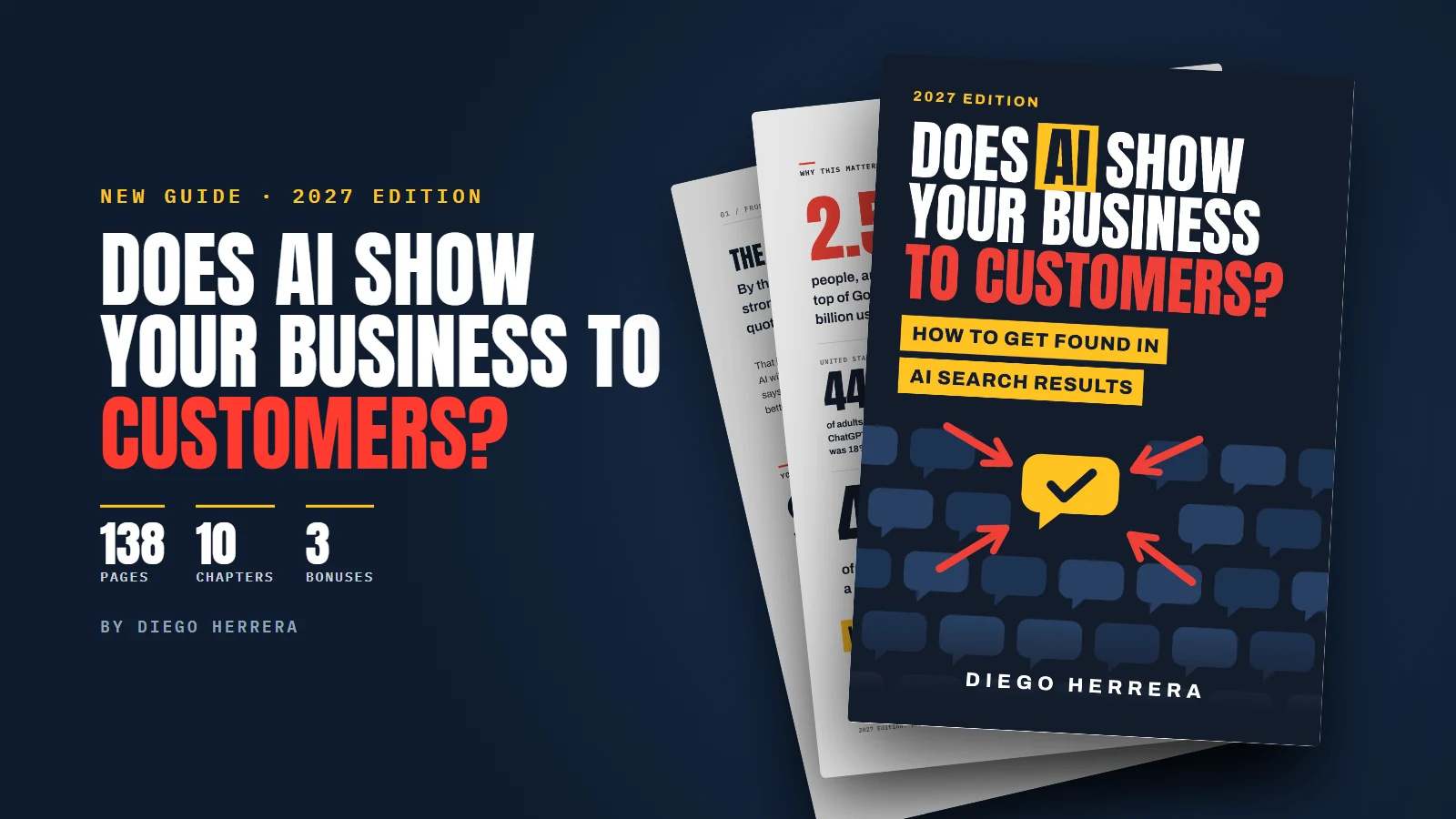
You’ve heard that customers are asking AI tools who to use, and you want to know whether a guide about it is worth your time. "Does AI Show Your Business to Customers?" (2027 Edition) is a 138-page PDF by Diego Herrera that shows business owners, step by step, how to become one of the handful of businesses AI names when a customer asks. If you run a local or service business and can spare an hour or two a week, it is written for you.
Why did Diego Herrera write a guide about AI search?
Diego has built thousands of websites for sole traders through to government organisations in the UK and across Europe since 2003, and the method in the guide is the same one he uses for his own clients: answer first, sell second. The guide is not a theory; it is the documented version of work already done for paying clients.
"I’ve been involved in development for over 20 years. Throughout that time I’ve taught and helped people where I can. This is an extension of that."
Why does AI search matter for a small business right now?
Customers have largely stopped typing keywords and started asking full questions, and AI tools name only a handful of businesses in each answer, so if nothing clear has been written about you, you are left out. Three pieces of research show how fast this is moving.
In a survey of 1,002 US adults, published in February 2026, BrightLocal (which sells local marketing tools) found that use of AI tools for local recommendations had risen from 6% to 45% in a single year. Separately, Pew Research Center asked 5,119 US adults in early 2026 and found that 44% reported using ChatGPT, up from 18% in 2023; and Ofcom, in research on 7,533 UK adults published in April 2026, found that more than half (54%) of UK adults now use AI tools, up from around three in ten a year earlier. All three figures are from single countries and survey different things, so treat them as a direction of travel rather than a precise count.
The book puts it plainly: most businesses are left out "because nothing clear has been written about them for the AI to read" (p.17). You can’t control what the AI says, but you can control what there is for it to find.
What does the guide cover, chapter by chapter?
Ten chapters take you from a ten-minute test on day one through to a 90-day plan, each ending in something to do. Here is the sequence.
Chapter 1: From searching to asking. Explains what changed, why customers now ask whole questions instead of typing keywords, and how to run the ten-minute test (p.19) that gives you your starting line.
Chapter 2: How AI decides who to mention. Shows the four things AI looks for in a page: a direct answer early, clear headings, facts with sources, and signs of a real business (pp.25 to 27). It also covers the one technical door you must leave open: the robots.txt file that lets AI search crawlers in.
Chapter 3: Find the questions your customers ask. Introduces the difference between direct questions (someone ready to choose) and upstream questions (someone with a worry, not yet looking for a business). Five places to find real questions are listed, and the chapter ends with a half-hour exercise to build your first question bank.
Chapters 4 to 6: Write answers AI can quote. Chapter 4 lays out the eight parts of a quotable article, in the order they must appear. Chapter 5 walks through four finished examples (fitness, property, travel and law), annotated. Chapter 6 is a practical writing session using an eight-prompt chain, with advice on where AI drafts help and where you must bring your own facts.
Chapter 7: Show you’re real. AI reads more than your website: it reads your Google Business Profile, your reviews, your social accounts and your videos. Chapter 7 covers each in turn.
Chapter 8: The technical bits, made simple. Two no-code jobs: schema labels and Google Search Console, including the Generative AI report that opened to every site on 31 August 2026.
Chapter 9: What not to do. Three kinds of mistake, the tricks that backfire, and the things you cannot buy.
Chapter 10: Keep it going. Honest expectations, a one-page checklist, the first 90 days drawn out week by week, and a day-90 scorecard.
What do you receive when you buy the guide?
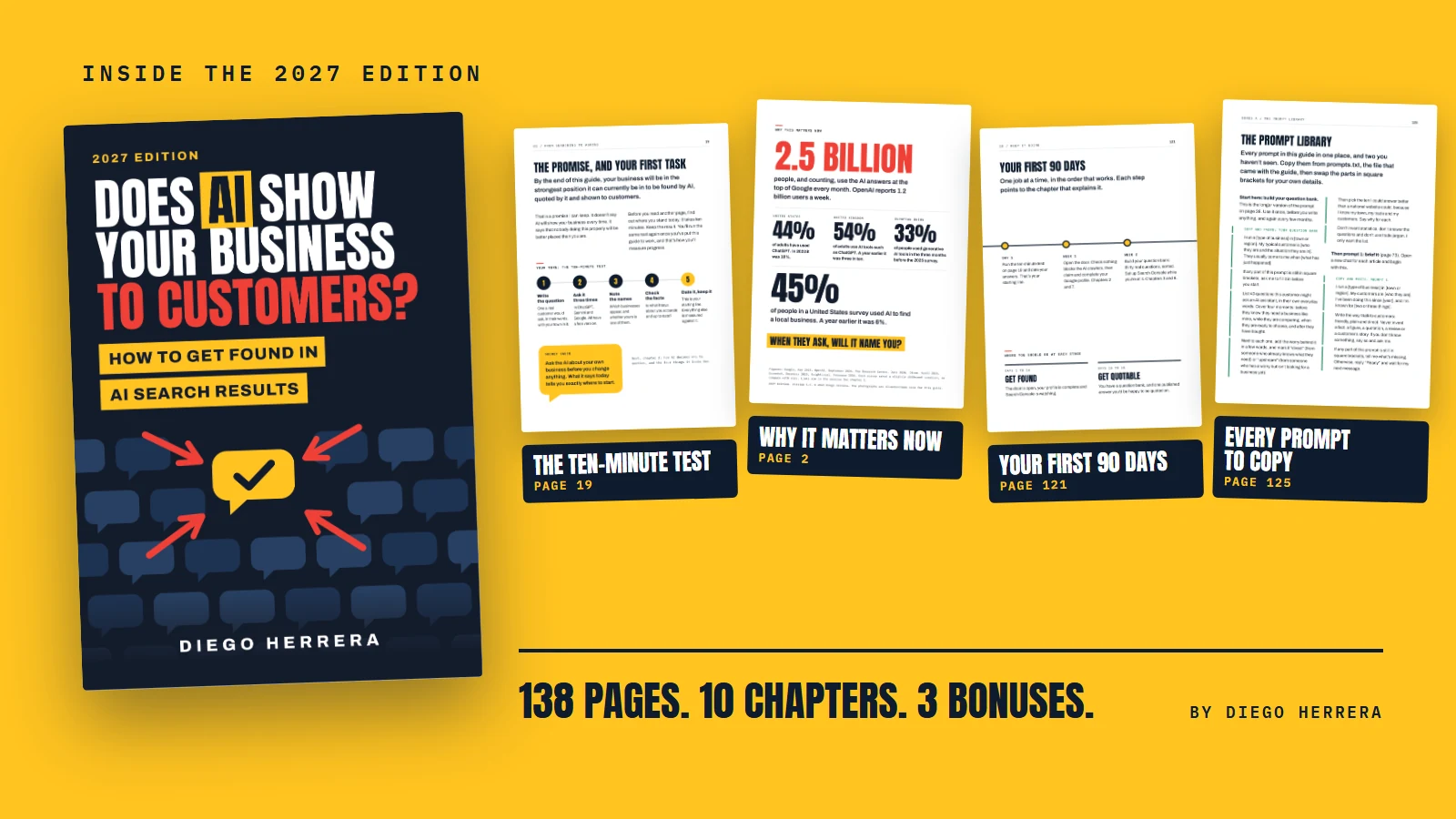
You get the 138-page designed PDF, a paste-ready text file of every prompt, three bonuses, and free updates to every later edition. The table below shows what is included.
| What you get | What it does |
|---|---|
| Ten chapters | Takes you from the ten-minute test on day one to a 90-day plan |
| Prompt library (Bonus A) | Every prompt on its own pages, plus a paste-ready text file |
| Industry questions (Bonus B) | Five starter questions for each of ten industries |
| Printable worksheets (Bonus C) | A one-page article template and a monthly scorecard |
| Free chapter 1 | Twenty pages on the home page; full chapter at /read-chapter-1/ |
| Free updates | Every later edition is free to anyone who buys this one |
What is inside the guide at a glance
No paid tools are needed: everything in the guide works with the free versions of ChatGPT, Gemini, Claude and Google’s own tools.
Who is this guide for, and who is it not for?
It suits anyone who runs a business or looks after its marketing, whose customers find them online, who would rather be told plainly what to do, and who can spare an hour or two a week. The guide is built around local and service businesses, but the writing and visibility chapters apply to anyone whose customers ask questions before they buy.
It is not for anyone who wants a guaranteed place in an AI answer, a shortcut without writing anything useful, or a fix by the weekend. The guide is clear on this: "I can’t promise AI will show your business every time, and nobody honestly can." (p.7) The 90-day plan takes three months of consistent effort. The guide names anyone who promises otherwise.
What does the guide promise, and what does it refuse to promise?
The guide’s own words on p.19 state its aim: "By the end of this guide, your business will be in the strongest position it can currently be in to be found by AI, quoted by it and shown to customers." That is the promise.
What it refuses is a guarantee of placement. OpenAI says "placement is not guaranteed" (p.30); Google has always said the same about search. The guide is built on that honesty, and it carries a 14-day money-back guarantee.
If you would like to read before you decide, twenty pages are on the home page and the full first chapter is free at /read-chapter-1/.
Three things to take away
An example
A personal trainer who coaches people in their fifties, sixties and seventies rewrites one vague service page as "How do I start exercising again after 50?" and answers it in the first three sentences, with a World Health Organization figure as the proof. That single article is the kind of thing AI tools can quote when a customer asks the same question.
A hot tip
Run the ten-minute test on page 19 before you change anything: ask ChatGPT, Gemini and Google a question a real customer would ask, with your town in it, and note whether your business is named. That is your starting line.
A warning
The 90-day plan is a plan, not a shortcut: the guide is clear that it takes consistent effort over three months, not a fix by the weekend. As the guide says on page 7, "Anyone who says they have it all worked out is selling something."
Quick questions about the AI search guide
Do I need to buy any paid AI search tools to follow the method?
No. Everything in the guide works with the free versions of ChatGPT, Gemini, Claude and Google’s own tools.
How long does the AI search method take each week?
The 90-day plan lays it out week by week; expect to spend an hour or two a week.
Can the guide guarantee my business appears in AI search results?
No, and it says so plainly on page 7: "I can’t promise AI will show your business every time, and nobody honestly can."
What if AI search changes after I buy the guide?
Every later edition is free to anyone who buys this one.
Where can I read part of the AI search guide before deciding whether it applies to my business?
Twenty pages are on the home page, and the full first chapter is at /read-chapter-1/.
Sources
- BrightLocal, “Local Consumer Review Survey 2026”, 11 February 2026. brightlocal.com
- Pew Research Center, “Americans and AI 2026”, 17 June 2026. pewresearch.org
- Ofcom, “Adults’ Media Use and Attitudes”, 2 April 2026. ofcom.org.uk
Leave a Reply