
Open ChatGPT and type the question a real customer would ask, in their own words, with your town in it: something like "Who are the best AI search consultants in London? Give me a list of five." Then run the same question in Gemini and Google, check what each says about you, and write the date down. Do it once a month, because one answer proves nothing: the names change from ask to ask.
What question should I ask ChatGPT to check my business?
Write it the way a real customer would say it, with your town in it and a full question, not a keyword: for example, "Who are the best AI search consultants in London? Give me a list of five." The more it sounds like a person talking, the more useful the result.
People have stopped typing keywords and started asking full questions, and a full question tells you who the customer is, what worries them and how soon they need help. In the United States, 44% of adults now report using ChatGPT, up from 18% in 2023, according to a Pew Research Center survey published in June 2026; the 2026 question wording also covered other chatbots, not ChatGPT alone.
Where else should I check besides ChatGPT?
Run the same question in Gemini and in Google as well, because each tool has its own way of searching and may name different businesses. All three have a free version.
| Step | What to do |
|---|---|
| Write the question | One a real customer would ask, in their words, with your town in it |
| Ask it three times | In ChatGPT, Gemini and Google. All have a free version |
| Note the names | Which businesses appear, and whether yours is one of them |
| Check the facts | Is what it says about you accurate and up to date? |
| Date it, keep it | This is your starting line. Everything else is measured against it |
The ten-minute test: five steps from the book (chapter 1, page 19)
One more step the book adds, as its Secret sauce on page 19: ask the AI about your own business by name before you change anything. What it says today tells you exactly where to start.
Why does ChatGPT name different businesses each time I ask?
AI tools rarely give the same list twice: a volunteer study published by SparkToro in January 2026 found they repeated the same set of names in fewer than one run in a hundred, across 2,961 runs. One result is a sample, not a verdict.
The study, run by Rand Fishkin, asked 600 volunteers to put 12 prompts through ChatGPT, Claude and Google’s AI Overviews or AI Mode in November and December 2025. It wasn’t peer reviewed, and Fishkin says "we aren’t professional researchers"; SparkToro sells audience research software, and his partner works at Gumshoe, which tracks AI visibility. Read it as a signal rather than settled science, but the direction is clear: a single answer tells you very little.
What should I do if AI gets my business details wrong?
Note exactly what is wrong and where, then fix it at the source: your website, your Google Business Profile, and any listings the AI may have read.
AI tools read what is already on the web. If your opening hours are wrong in an AI answer, check your website and your Google Business Profile first: if they are wrong or missing there, that is where to put them right. The "Check the facts" step in the table above is just as important as seeing your name in the list. The test puts that check alongside the name check from day one, as part of your starting record.
How often should I check whether AI recommends my business?
Once a month is enough. The book’s one-page checklist on page 120 puts the ten-minute test on a monthly cycle.
The shift towards AI for local recommendations is real and fast: the share of US adults using AI tools for local recommendations rose from 6% to 45% in a single year, according to BrightLocal’s Local Consumer Review Survey 2026, published in February 2026, covering 1,002 US adults; BrightLocal sells local marketing tools. In the UK, more than half of adults now use AI tools, according to Ofcom’s Adults’ Media Use and Attitudes report published in April 2026. Both figures are for their own country only.
Run the test once a month, keep a dated record, and judge the trend over months, never a single reply.

What does the book cover about this?
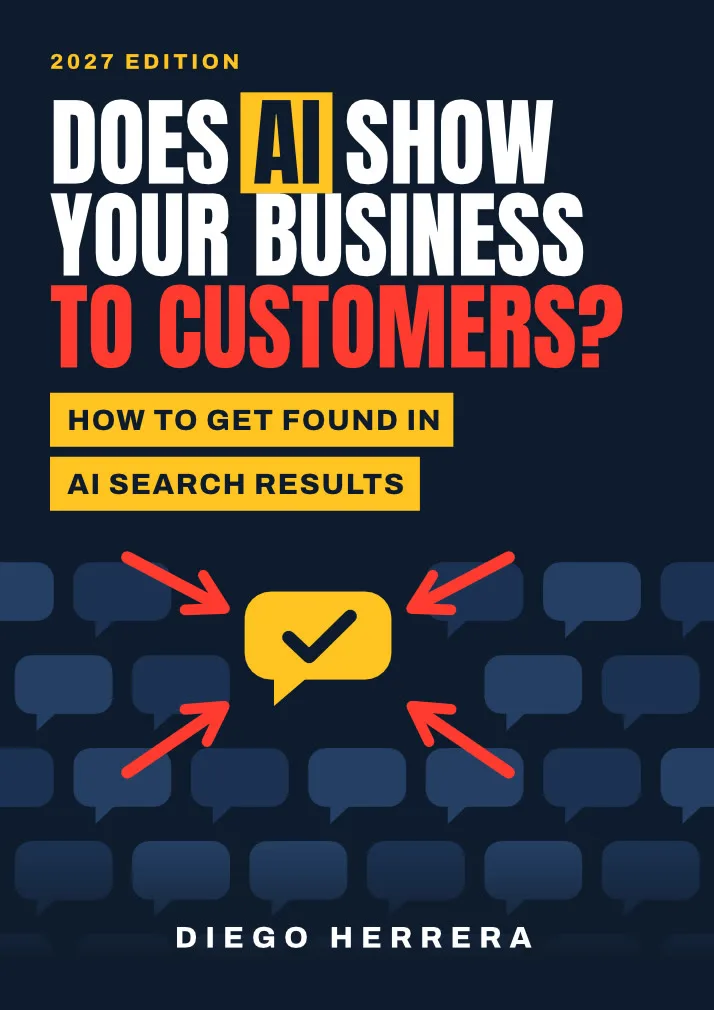
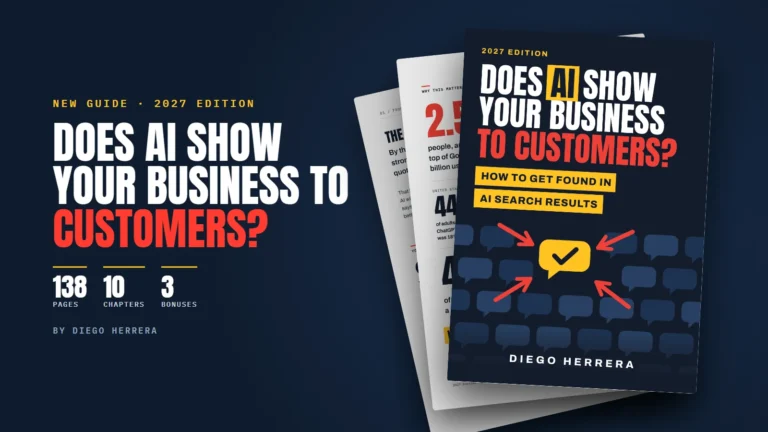
Does AI Show Your Business to Customers? (2027 Edition) by Diego Herrera opens with this exact test. Chapter 1, page 19, gives you the full five-step ten-minute test, along with the Secret sauce step of asking the AI about your business by name before you make any changes.
Chapter 10, page 121, has a plan for your first 90 days, one job at a time, in the order that works, with the test at day one. The one-page checklist on page 120 keeps the test on a monthly cycle from then on.
The full ten-minute test is in the free first chapter, so you can try it today before you decide anything else.
Three things to take away
An example
A reformer Pilates studio owner types "Where can I try reformer Pilates for the first time in Bristol?" into ChatGPT, Gemini and Google. She notes which tools named her studio, writes down the date, and spots that one tool has her opening hours wrong.
A hot tip
Ask the AI about your business by name as well as by category: what it says today tells you exactly where to start. Do this before you change anything on your website or listings.
A warning
Don’t judge on a single answer. In a volunteer study by SparkToro (which sells audience research software), AI tools gave the same list of names fewer than once in a hundred runs, so one result is a sample, not a verdict.
Quick questions about checking if AI recommends your business
Do I need a paid account to run this test?
No: ChatGPT, Gemini and Google all have free versions.
How long does the test take?
About ten minutes.
Should I also ask the AI about my business by name?
Yes, before you change anything, so you know exactly where you stand.
Does it matter where I am when I ask?
It can: ChatGPT may share your general location with its search providers.
How do I know if the result is typical?
Ask the same question more than once; in a SparkToro volunteer study published in January 2026, the names changed in nearly every run.
Sources
- Rand Fishkin, SparkToro, “NEW Research: AIs are highly inconsistent when recommending brands or products”, 28 January 2026. sparktoro.com
- Pew Research Center, “Americans and AI 2026: Chatbots, Smart Devices and Views on Impact”, 17 June 2026. pewresearch.org
- Ofcom, “Adults’ Media Use and Attitudes”, 2 April 2026. ofcom.org.uk
- BrightLocal, “Local Consumer Review Survey 2026”, 11 February 2026. brightlocal.com
- OpenAI Help Center, “Searching the web with ChatGPT”, read 14 October 2026. help.openai.com
Leave a Reply