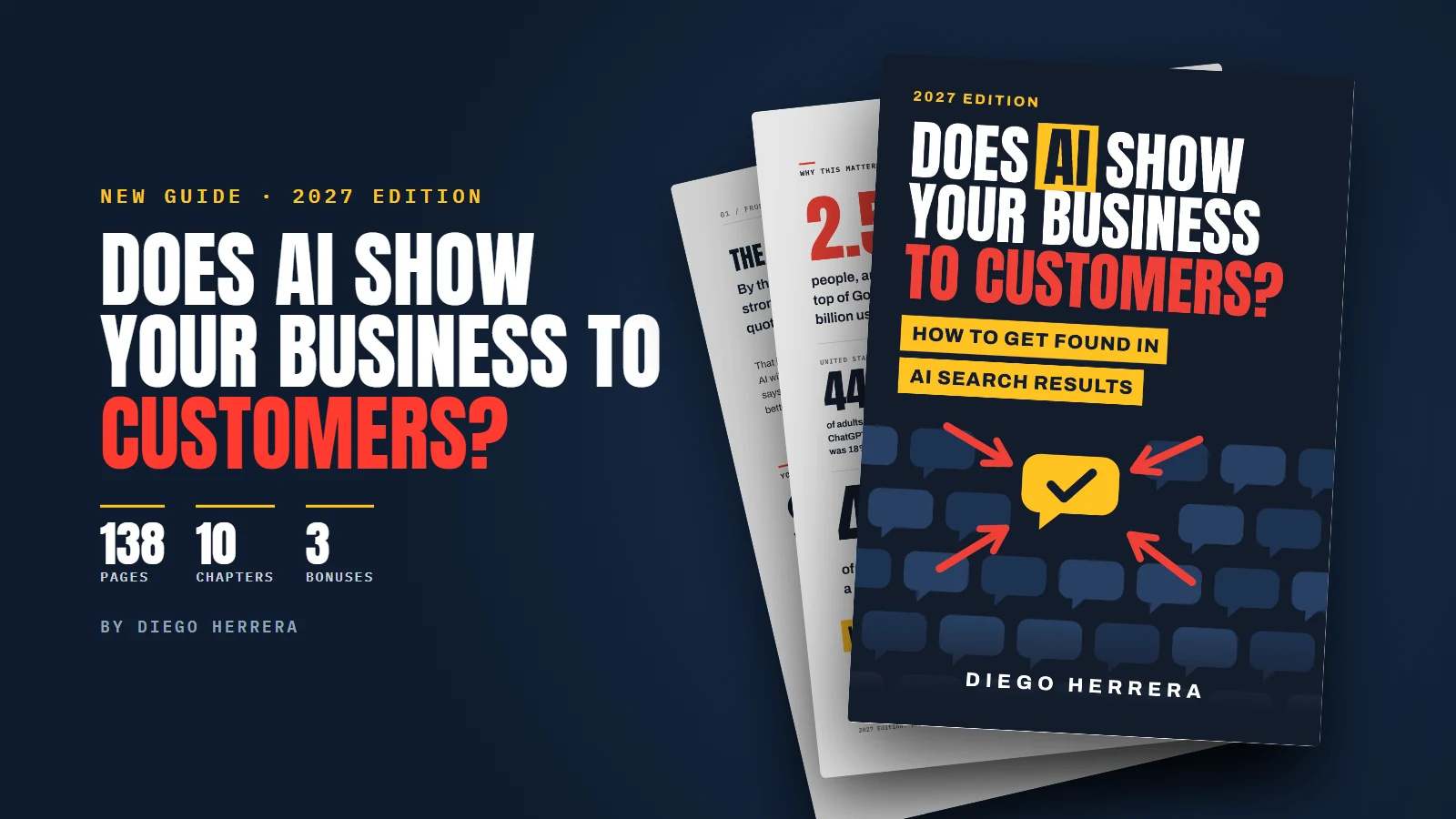
The words people use about AI search, in plain English. They come from the jargon buster at the back of Does AI Show Your Business to Customers?, the guide by Diego Herrera, and each one says which chapter of the guide covers it.
AEO
Answer engine optimisation. Much the same idea as GEO, under another name. Covered in chapter 2 of the guide.
AI Mode
Google’s newer AI search, where you ask a question and can keep asking. Covered in chapter 1 of the guide.
AI Overview
The AI-written answer at the top of a Google search. It was called SGE while it was an experiment in 2023. Covered in chapter 1 of the guide.
Citation
An AI answer naming or linking to a page as its source. A citation isn’t a visit. Covered in chapters 2 and 8 of the guide.
Crawler, or bot
A small program that visits and reads web pages. Covered in chapter 2 of the guide.
Direct question
One from someone who already knows what they need. Covered in chapter 3 of the guide.
E-E-A-T
Experience, expertise, authoritativeness and trustworthiness: the four words Google’s guidance on helpful content uses. Covered in chapter 2 of the guide.
GEO
Generative engine optimisation: making content more visible in AI answers. Covered in chapter 2 of the guide.
Google Business Profile
The panel that appears when you search for a business on Google or on Google Maps. Covered in chapter 7 of the guide.
Grounding queries
The searches an AI ran to find you. Covered in chapter 8 of the guide.
ICP
Ideal customer profile: a few lines on the customer you most want and where they spend their time. Covered in chapter 7 of the guide.
Impression
One showing of a link to your site, whether or not anyone clicked it. Covered in chapter 8 of the guide.
LLM
Large language model: the technology underneath ChatGPT, Gemini and Claude. Covered in chapter 2 of the guide.
Prompt
What you type into an AI tool to tell it what you want. Covered in chapter 6 of the guide.
Query fan-out
An AI turning your one question into several searches. Covered in chapter 2 of the guide.
Question bank
A list of real customer questions that you keep adding to. Covered in chapter 3 of the guide.
Rich result
A fuller listing in Google, such as one showing a date, opening hours or the length of a video. Covered in chapter 8 of the guide.
robots.txt
A file on your website that tells each crawler whether it’s welcome. Covered in chapter 2 of the guide.
Schema, or structured data
Labels in a page’s code that say what each thing is. Covered in chapter 8 of the guide.
Search Console
Google’s free report on how your site is doing in its search. Covered in chapter 8 of the guide.
SEO
Search engine optimisation: helping search engines understand your pages, and helping people find them. Covered in chapter 2 of the guide.
Service-area business
One that goes to its customers, so its profile shows the area it covers and not an address. Covered in chapter 7 of the guide.
Sitemap
A file that lists the pages on your website for search engines. Covered in chapter 8 of the guide.
Upstream question
One asked earlier, by someone who has a worry but isn’t looking for a business yet. Covered in chapter 3 of the guide.
Zero-click
A search that ends without a click on any website, because the answer was already on the page. Covered in chapter 2 of the guide.
Want the whole method, in plain English?
Read the first chapter free, including the ten-minute test that shows whether ChatGPT, Gemini and Google name your business today. Or get the guide.